Use existing soil
The soil stays on site and becomes the base. No excavated material to haul away.
See the cross-sectionTERRA3000 by TERRASALES
TERRA3000 is a liquid binder milled straight into the existing soil. The topsoil is removed and the soil below is treated in place to form a load-bearing layer. No soil replacement, no excavation crews, no imported gravel.
Conventional construction
12–14days
With TERRA3000
approx.1day
01 · Product
Conventional road construction digs the soil out, hauls it away and replaces it with about 5 layers of sand, gravel and crushed stone. TERRA3000 works the other way round: the existing soil is milled, mixed with TERRA3000 and water, and compacted into a solid, load-bearing layer.
The result is the base for the road above. A surface of asphalt or chippings is added when the project needs one.
Same ground. Same road. Reinvented from within.
TERRA3000Manufacturer figure
Values from the TERRASALES machine sequence. Whether they apply to a given project is decided per site.
02 · Process
We follow the same section from the first cut to the final test. Each step takes its time; nothing happens at the push of a button.
The topsoil is removed, then the formation is cut and levelled.
A soil mill with injection and tank works TERRA3000 in to about 30 cm. A water tanker supplies the water.
The grader levels the treated layer again and brings it to profile.
Heavy rollers knead and compact the layer. A falling-weight test measures the bearing capacity.
Afterwards, depending on the project
03 · Comparison
Same road, a different route to the base. Pick a metric.
Until the base is finished, not until the road is finished. Manufacturer figure for a reference project.*
Shown as an index, conventional build-up = 100. Manufacturer figure; the cost basis of the reference project is still being documented.*
Each square is one avoided trip. Manufacturer figure for a reference project.*
Conventional construction
With TERRA3000
Less excavation, fewer transports, no imported stone: that keeps tons of CO₂ out of the air.
A verified CO₂ calculation is not yet available, so we do not give a number here.
Illustrative model: it scales the manufacturer figures linearly with length, assuming a reference section of 1 km. Not a calculation and not a quote. For real figures we check your site.
04 · Cross-section
On the left the usual build-up with about 5 installed layers, on the right the soil stabilised with TERRA3000. Drag the slider or pick a layer.
Conventional construction / approx. 5 layers, delivered
With TERRA3000 / 1 stabilised layer from existing soil
Conventional construction
Top layer of the carriageway.
Carries and spreads the load under the surface.
Crushed rock, delivered by truck.
Gravel and sand, delivered by truck.
The existing soil is dug out, hauled away and replaced.
With TERRA3000
Optional: chippings or approx. 5 cm bitumen. Not part of the stabilisation; a separate build-up when the project needs it.
The existing soil, mixed with TERRA3000 and water to about 30 cm, profiled and compacted.
Stays where it is. No excavation, no replacement.
05 · References
Pick a point to open the project.
Demo Demo projects: locations, figures and images are for illustration and will be replaced by real references.
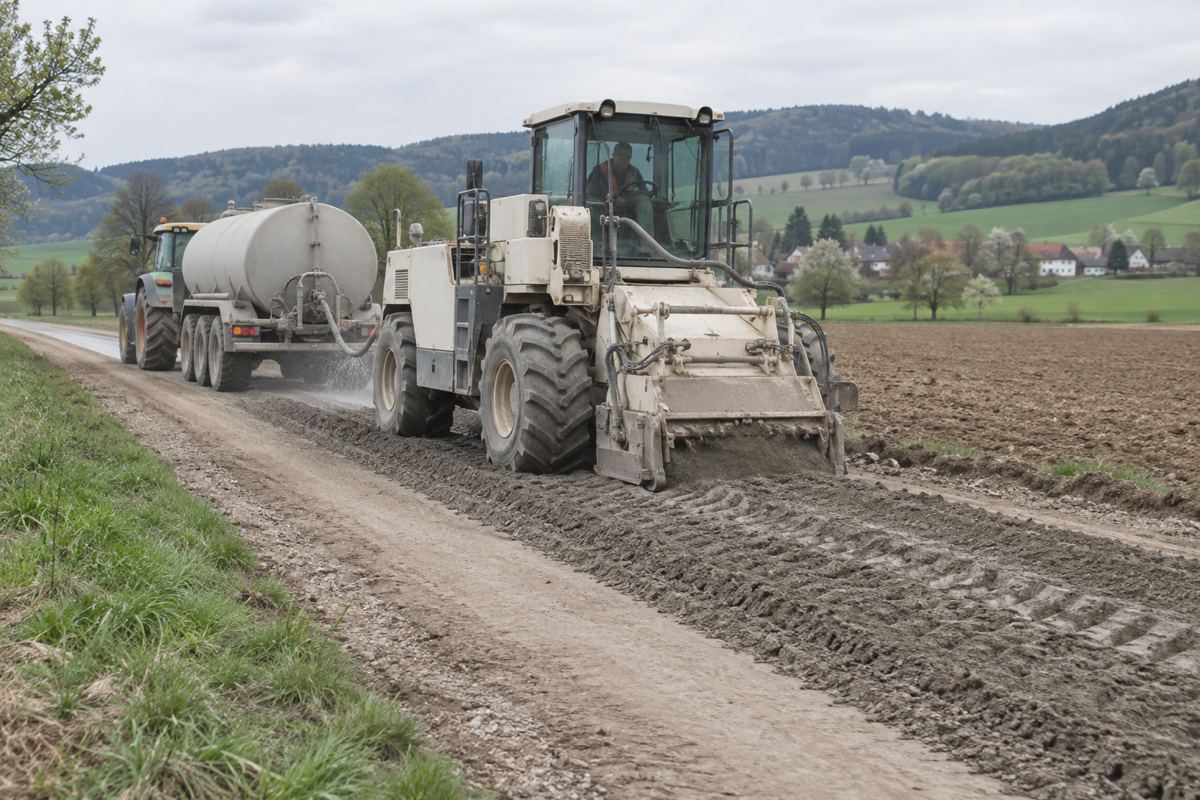
DemoFarm road
Germany · near Landshut, Lower Bavaria
An agricultural road between two farms, until then an unpaved field track. The soil was stabilised in place with TERRA3000 and finished with a chippings layer.
Demo projects: locations, figures and images are for illustration and will be replaced by real references.
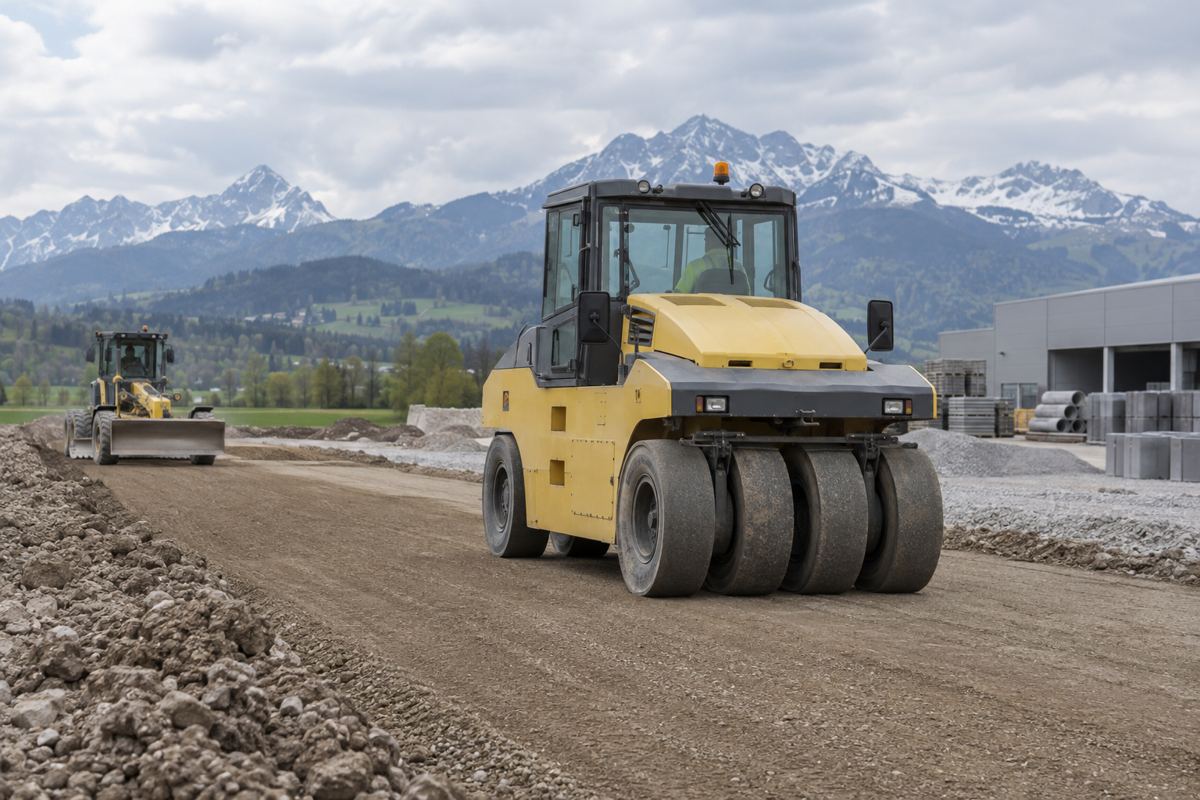
DemoIndustrial access
Austria · near Wels, Upper Austria
An access road for heavy delivery vehicles to an industrial yard. The stabilised base then received a bitumen surface of about 5 cm.
Demo projects: locations, figures and images are for illustration and will be replaced by real references.
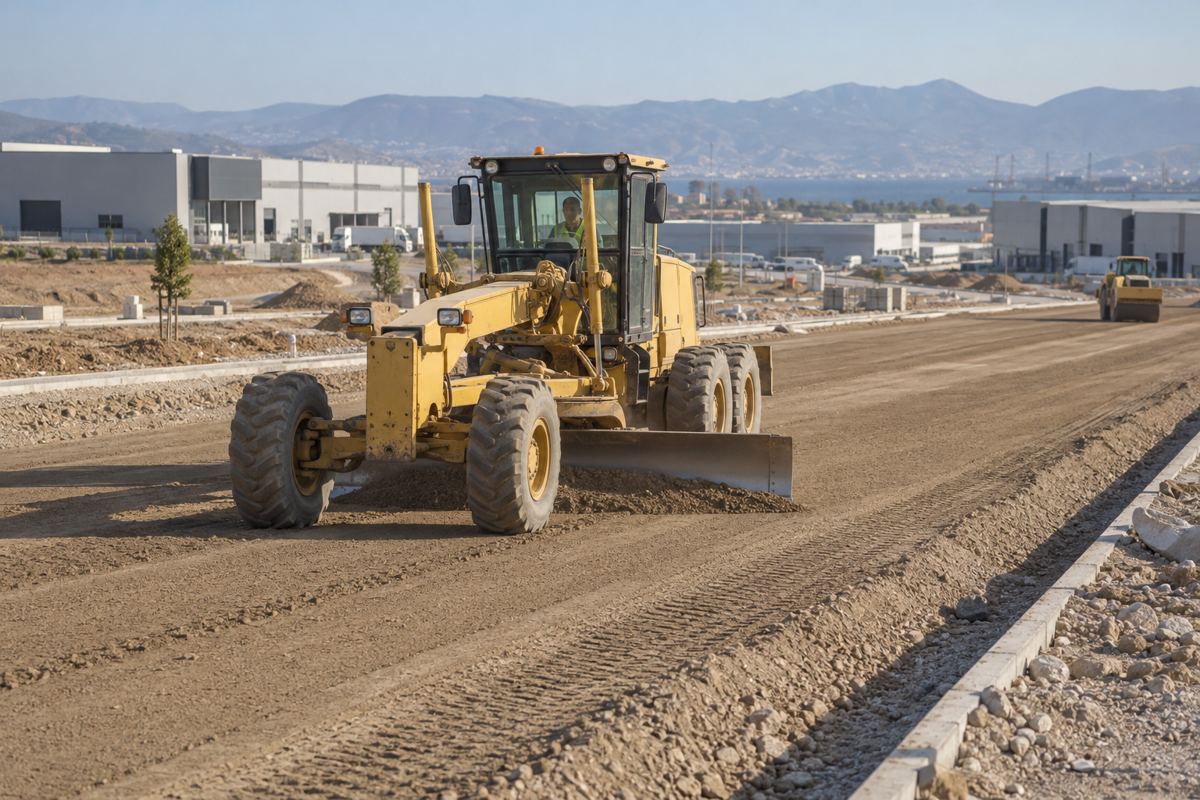
DemoLogistics site
Türkiye · Kemalpaşa, İzmir
The internal access road of a new logistics park. Several sections were stabilised one after another so the warehouse sites could be reached early.
Demo projects: locations, figures and images are for illustration and will be replaced by real references.
This is how references will look here. Every figure in this section is example data, not a completed project.
| Project | Location | Length | Base construction time | Project budget | Revenue | Truck trips avoided | Surface |
|---|---|---|---|---|---|---|---|
| DemoFarm access road | near Landshut, Lower Bavaria | 2.4 km | 3 days | €410,000 | €265,000 | 190 | Chippings |
| DemoIndustrial yard access road | near Wels, Upper Austria | 1.1 km | 2 days | €520,000 | €310,000 | 140 | Bitumen, approx. 5 cm |
| DemoLogistics park access road | Kemalpaşa, İzmir | 3.6 km | 5 days | €1,280,000 | €760,000 | 420 | Bitumen, approx. 5 cm |
06
The soil stays on site and becomes the base. No excavated material to haul away.
See the cross-sectionAbout 1 day instead of 12–14 days until the base is finished. The stretch is free sooner for the next works.*
See the comparisonMore than 80 truck trips avoided, less traffic on the roads around the site.*
See the comparison07
This is where the certificates, test reports and standards TERRA3000 is tested against will appear. We only show evidence that actually exists.
Product certificate
Placeholder Not yet confirmed
Name, issuer and number follow once TERRASALES confirms them.
European standard
Placeholder Not yet confirmed
The applicable EN standard is added once the technical team approves it.
Bearing capacity test report
Placeholder Not yet confirmed
Falling-weight test results from a reference project, once released.
Environmental and material evidence
Placeholder Not yet confirmed
Added once evidence is available.
08 · FAQ
A liquid binder for soil stabilisation. A soil mill works it into the existing soil together with water. After profiling and compaction it forms a solid, load-bearing layer.
The topsoil, about 30 cm of humus, is removed. The soil below is not dug out and replaced but treated in place.
After about one day the base is in place; in a conventional build-up that takes 12–14 days. A surface of asphalt or chippings is added depending on the project.
The project decides: a chippings layer or a bitumen surface; per the manufacturer, about 5 cm is enough. Other build-ups are agreed case by case.
We check that for every site. Suitability depends on the soil, the load and the planned build-up. Send us your project details.
Bulldozer, grader, soil mill with injection and tank, water tanker, rubber-tyred and smooth-drum rollers (each over 25 t) and a falling-weight device for testing.
Per the manufacturer, more than 50% of the cost and more than 80 truck trips in a reference project. What it means for you depends on length, soil, build-up and haul distances.
With an enquiry through the form. We get back to you, clarify the key data and check the site.
Yes. Write to us if you want to use TERRA3000 in your projects or work with us.
09
Describe your project briefly. We will get back to you with the next steps.